

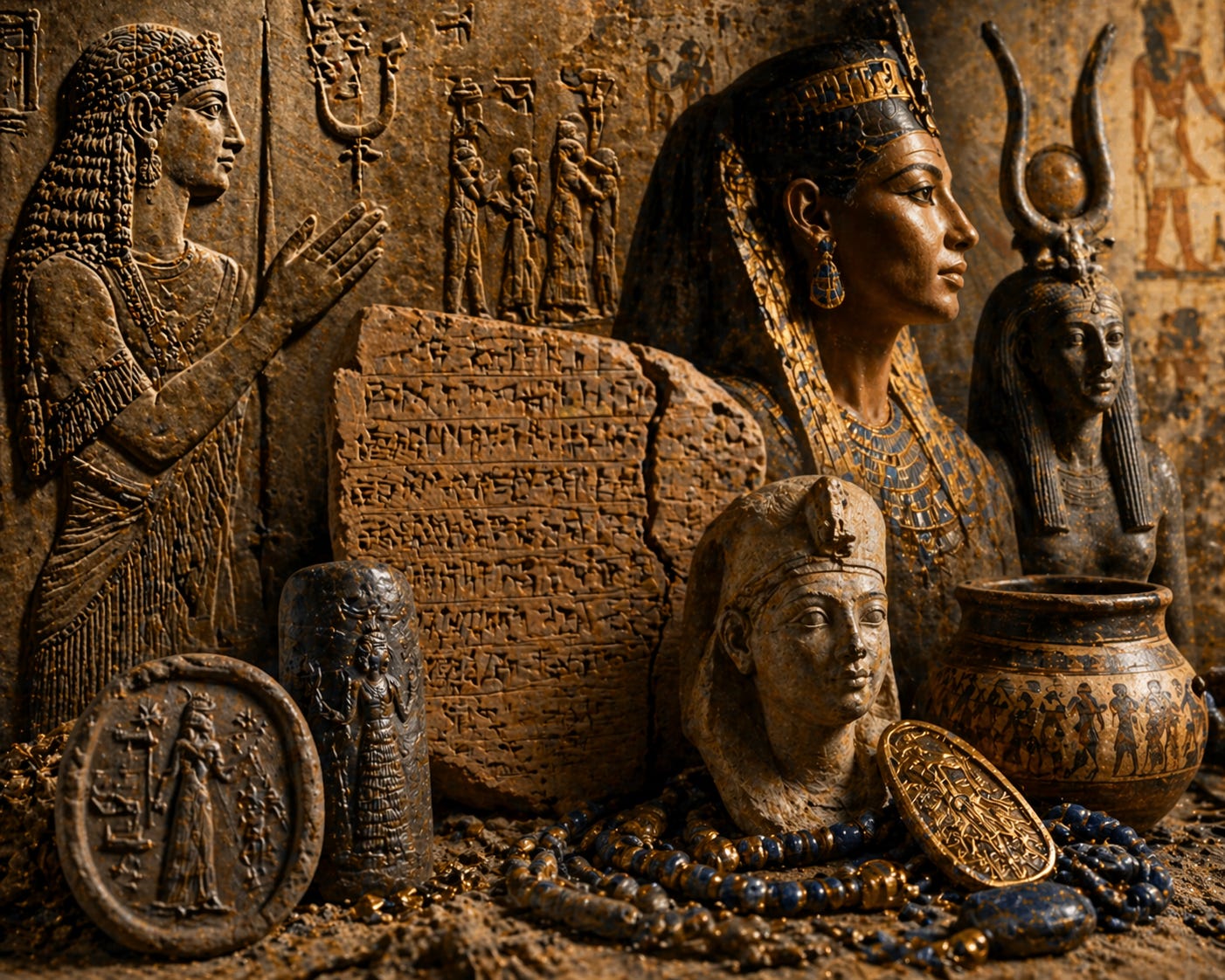
Before women appear in the historical record by name, they are still everywhere in the human story. They are present in continuity, survival, labor, kinship, ritual, care, and collective life. But they are not yet individually legible to us. We know them through traces, not names. Through what was carried, buried, made, survived, and passed on.
Then the record sharpens.
And even that sharpening tells its own story.
The first women we meet by name do not enter a neutral archive. They enter a world already narrowing around power, lineage, priesthood, wealth, and rule. They appear not because history suddenly became interested in women as full human beings, but because some women stood close enough to religion, royalty, or dynastic importance to become difficult to omit entirely.
That matters. From the beginning, the written record does not simply preserve women. It filters them.
It gives us women who were elite enough, sacred enough, dynastic enough, or proximate enough to power to leave a mark. It does not give us the full field of women who sustained those worlds. What survives is often partial. A title. A tomb. A seal impression. A hymn. A disputed regency. A name attached to power, but not always full clarity about the shape of that power.
Still, the names matter. They tell us women were there, not outside the making of civilization, but inside its early religious, dynastic, and political life.
Enheduanna is one of the clearest early examples. A high priestess in Mesopotamia, and often regarded as the earliest known author named in history. She stands at the meeting point of religion, empire, and language.
She matters not simply because she was a woman who wrote, but because her existence breaks the lazy myth that women arrived late to thought, authorship, and public meaning. She appears near the beginning of the written world. Already speaking from within one of its most powerful institutions.
Queen Puabi appears differently. Known through her royal tomb at Ur, she survives through burial, regalia, and elite presence. Her story reminds us that some women entered the record not through their own voice, but through the visibility of rank.
Even there, she is not nothing. She stands as evidence that women could occupy positions of wealth, status, and ceremonial importance in early urban life. But the record around her is still shaped by what power chose to preserve.
In early Egypt, women such as Merneith and Neithhotep appear close to the origins of dynastic rule. Their names survive because they stood near kingship itself, perhaps as regents, perhaps as rulers in fuller measure than the later record comfortably admits. And that discomfort matters.
When early female authority appears, uncertainty often gathers around it. Was she truly ruling, or only holding place for a man? Was she sovereign, or simply adjacent? Was her power real, or must it be explained back into acceptability? The questions are familiar. The archive does not only preserve women. It also reveals the strain of trying to contain what it cannot fully erase.
That is the first narrowing.
Women enter the record, but not on equal terms. They appear through priesthood, dynasty, wealth, burial, and proximity to rule. They are visible, but unevenly. Named, but not always fully legible. Present, but already pressed into forms the archive knows how to keep.
And still, their presence matters because it destroys a convenient lie.
Women were not absent from early civilization. They were not wandering outside the walls while men built the first states, the first temples, the first cities, and the first written worlds. They were there. In sacred office. In dynastic continuity. In elite households. In political transition. In burial chambers rich enough to force remembrance. In language itself.
But from the moment they begin to appear, we can also see the limits closing around them.
The written record opens, and already it is selective. Already it is structured by hierarchy. Already it is more prepared to preserve a woman when she serves empire, lineage, religion, or royalty than when she stands simply as herself. The first named women do not enter history on equal ground. They enter through the doors power left open.
That is why this stage matters.
The move from collective human emergence to recorded civilization does not suddenly make women clear. It makes the filtering clearer. We begin to see not only that women were present, but how the archive itself was shaped to keep some forms of female importance and lose others.
So the first named women should not be read as rare exceptions floating above an otherwise male world. They should be read as early signs of something larger. Women had always been present in the making of human life.
Now, at last, some of them become visible by name. But they enter a record already built to narrow what female authority could look like, how it could be remembered, and under what conditions it could be allowed to remain.
That narrowing will only deepen from here.
What is preserved
is not what existed,
but what could be held
within the structure that recorded it.