

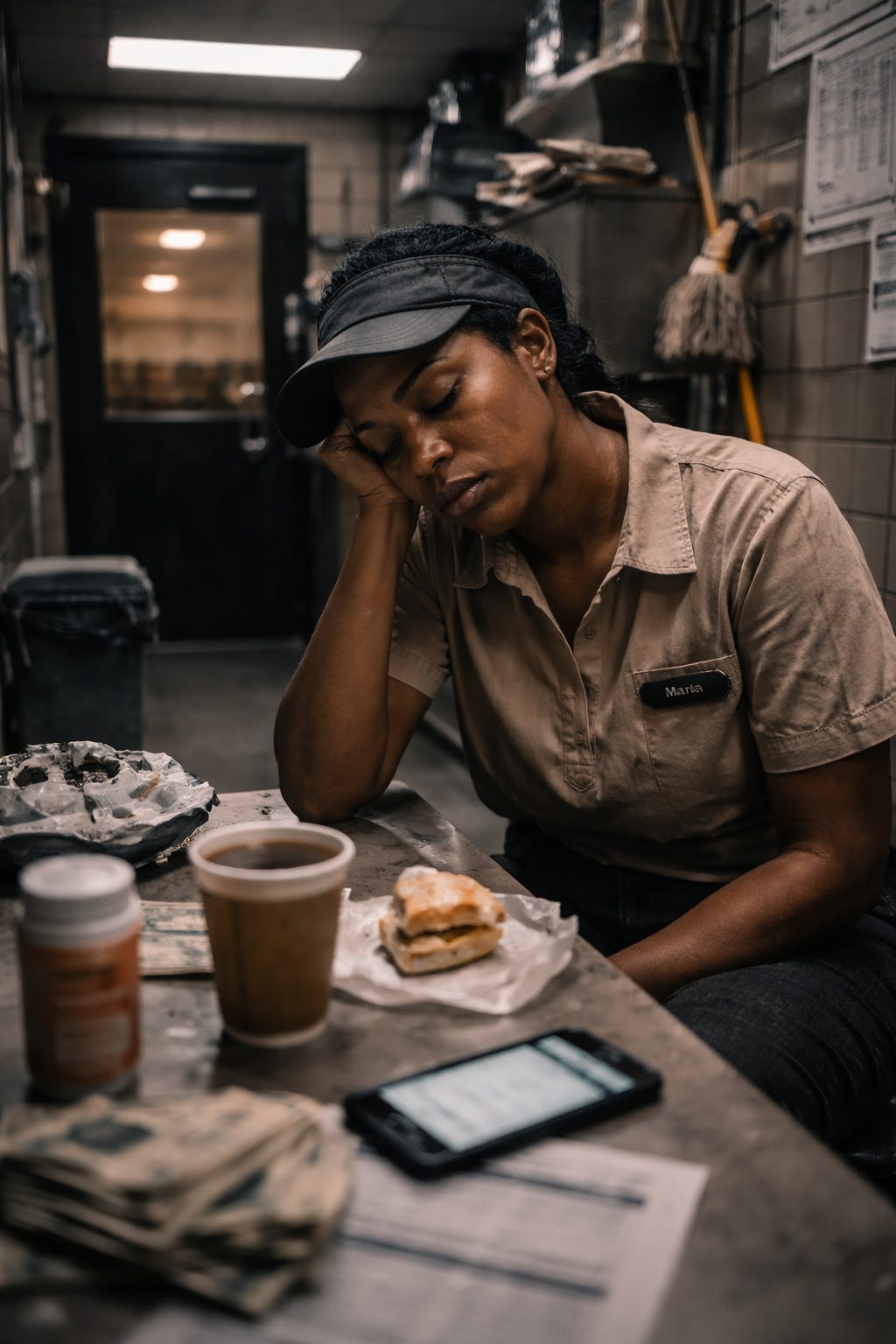
In the United States, work is treated as the price of survival. Recovery, rest, family care, and basic worker protection are treated as perks. That is not a minor policy flaw. It is a structural choice. Federal law still sets the minimum wage at $7.25 an hour, where it has remained since July 24, 2009. Federal law also does not require private employers to provide paid vacation, paid holidays, or paid sick leave. The main federal family-medical leave law provides eligible workers with unpaid, job-protected leave.
That is the failure.
A country that ties food, housing, healthcare, family stability, and basic security this tightly to employment should guarantee the conditions that make work livable. It should guarantee that wages can sustain life. It should guarantee time off, sick leave, parental leave, and meaningful worker protections. Instead, the United States demands extraordinary dependence on work while maintaining a labor floor that is weaker than many of its peers on exactly those points.
This is not some unavoidable fact of modern life. Other wealthy countries built a different baseline. Under EU working-time rules, workers are entitled to at least four weeks of paid annual leave, along with minimum daily and weekly rest periods. EU work-life balance rules also guarantee at least 10 working days of paternity leave around childbirth, paid at least at the national sick-pay level.
OECD reporting says paid maternity leave across OECD countries averages 18.5 weeks, and the United States stands out as the only OECD country with no national statutory paid maternity leave. OECD also reports that 35 of 38 OECD countries provide paid leave for fathers. So this is not a gap in imagination. It is a refusal.
The United States knows how other countries handle wages, leave, and labor standards. It knows stronger protections exist. It knows workers elsewhere are granted guaranteed paid vacation, protected rest, and paid family leave as ordinary parts of labor law rather than special favors. And still this country keeps a weaker floor and tells people to take pride in enduring it. That is one of the ugliest parts of the arrangement.
Americans are taught to look at better protections elsewhere and respond not with recognition, but with national vanity. We are America. We are the best. They must be wrong. But the comparison cuts the other way. The federal baseline here is thinner, harsher, and less protective than what many peer countries require as a matter of ordinary law.
That makes this more than an economic failure. It is a moral one. Life is supposed to matter for more than production. The point of a society is not to grind people down just enough to keep the machine fed. The point is to protect life, give it room, and return some dignity to the fact that we are here at all.
But in the United States, people are underpaid, under-protected, under-rested, and driven to exhaustion inside a system that still expects gratitude. They are given just enough time to recover for another brutal week that may still fail to provide enough security while extracting more from their bodies, relationships, and attention than a decent society should demand.
Benefits make the failure even clearer. In the United States, healthcare and other core protections are often tied to employment status instead of being secured as part of the public floor. That means stability is conditional twice over. First you must find work. Then you must hope the work offers enough benefits to keep your life from collapsing when illness, caregiving, or crisis arrives.
That is not a serious labor compact. It is an unstable bargain that relieves the state of responsibility while increasing worker dependence on employers. The federal leave floor reflects the same logic. If you are lucky enough to qualify, the major national leave guarantee is still unpaid.
And when work is built this way, it does not only harm workers on the job. It shrinks life outside the job. People lose time to participate, to create, to rest, to maintain relationships, to care for family, to think, to recover, and to inhabit their own lives as something more than labor inputs.
That damage does not stay private. It weakens families, communities, civic life, creativity, health, and the social patience that a functioning country depends on. A nation that treats people this way is not building strength. It is consuming the base that keeps it standing.
The peer comparison matters here because it strips away the favorite American excuse. This is not simply how the modern economy works. Other advanced countries disproved that already. They built stronger paid-leave rules, stronger rest protections, and stronger labor baselines into law. The United States did not fail to discover those options. It chose not to adopt them at the federal floor.
That is the Failure Point.
The failure is not simply that work is hard. The failure is that this country has built a labor system that makes survival deeply dependent on work while refusing to guarantee enough pay, enough leave, enough rest, and enough protection to make that bargain compatible with human dignity. It has accepted exhaustion as normal, under-protection as practical, and recovery as negotiable. It has watched peer countries do better and still chosen a weaker floor.
That is not strength. That is work without recovery.